
CSS / Reference / text-decoration: Decoration Propagation, Underlines, and Link Meaning
text-decoration is a shorthand for text decoration lines, styles, colors, and thickness. It can combine underlines or strike-through lines with different visual treatments.
Syntax and value choices
| Property | Initial value | Inherited | Main application conditions |
|---|---|---|---|
text-decoration |
none / solid / currentColor / auto | No | All elements; visible effects depend on the text, image, or box conditions below |
Initial values are not necessarily the values assigned to HTML elements by the browser’s stylesheet. Inspect the actual result in developer tools’ Computed panel.
a { text-decoration: underline solid #006c9c 2px; text-underline-offset: 0.2em; }
.deleted { text-decoration: line-through; }
| Value or category | Behavior and choice |
|---|---|
underline / overline |
Paint a line below / above the text. |
line-through |
Paint a line through the glyph area. |
solid / dotted / wavy |
Choose a line style. |
Color and thickness |
Specify the decoration’s color and width. |
none |
Do not originate a new decoration at this element. |
For supported values and conditions, see MDN text-decoration.
Run the example and compare results
Save this complete code as css-reference-10648-example.html in UTF-8 and open it in a browser. Keep its demonstration styles in that file rather than pasting them into a site-wide stylesheet.
<!doctype html>
<html lang="en">
<head>
<meta charset="utf-8">
<meta name="viewport" content="width=device-width, initial-scale=1">
<title>text-decoration comparison example</title>
<style>
body { margin: 0; color: #20242b; background: #fff; font: 16px/1.7 "Malgun Gothic", sans-serif; }
#demo { padding: 24px; max-width: 820px; margin: auto; }
h1 { font-size: 22px; margin: 0 0 20px; }
.samples { display: flex; flex-wrap: wrap; gap: 24px; }
.label { margin: 0 0 8px; font-weight: 700; }
.target, .reference { font-size: 26px; }
.target { text-decoration: underline wavy #006c9c 2px; text-underline-offset: 0.2em; }
.reference { text-decoration: line-through; }
</style>
</head>
<body>
<main id="demo">
<h1>text-decoration comparison</h1>
<section class="samples"><div class="a"><p class="label">Underline: wavy</p><div class="target">CSS text decoration</div></div><div class="b"><p class="label">Strike-through</p><div class="reference">CSS text decoration</div></div></section>
</main>
</body>
</html>
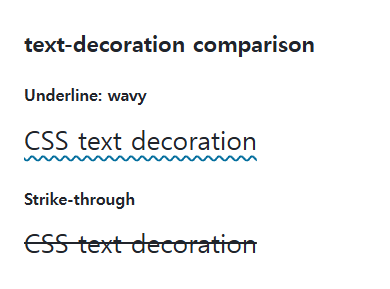
The first sample has a wavy underline; the second has a strike-through. An underline offset controls text-decoration placement, which differs from a border-bottom on a box.
A child cannot simply erase a parent’s line
Decoration propagation is different from ordinary property inheritance. A span with text-decoration: none can remain underlined by its parent. Apply the decoration to the correct content boundary instead of attempting to cancel its paint inside a child.
Links and meaningful deletions
Keep links distinguishable from surrounding prose and preserve keyboard focus indicators. Use del for meaningful deletion rather than inferring that meaning from CSS alone. Ink skipping can affect the final underline shape.
When an ancestor’s decoration reaches descendants
Save this complete document as css-reference-10648-practice.html in UTF-8 and open it in a browser. Test it as a separate file rather than nesting it inside another example.
<!doctype html>
<html lang="en">
<head>
  <meta charset="utf-8">
  <meta name="viewport" content="width=device-width, initial-scale=1">
  <title>When an ancestor’s decoration reaches descendants</title>
  <style>
    body { margin: 16px; color: #20242b; font: 16px/1.7 sans-serif; }
    main { max-width: 52rem; margin: auto; }
    h1 { font-size: 1.35rem; }
    .samples { display: flex; flex-wrap: wrap; gap: 24px; }
    .samples > * { max-width: 100%; min-width: 0; }
    :focus-visible { outline: 3px solid #005fcc; outline-offset: 3px; }
.parent {text-decoration:underline;} .child {text-decoration:none;} .only {text-decoration:underline;}
  </style>
</head>
<body>
<main>
  <h1>When an ancestor’s decoration reaches descendants</h1>
<p class="parent">Parent underline: <span class="child">Child none</span></p><p><span class="only">Only this span is underlined</span> <span>Undecorated text</span></p>
</main>
</body>
</html>
The child’s none does not cancel an underline drawn by the parent. This does not mean text-decoration is normally inherited. Apply decoration directly to the needed span as in the second paragraph. Change only the first parent’s underline to none, compare, and restore it. Real links still need recognizable styling and a visible focus state.
For real links’ default, visited, hover, and keyboard-focus presentation, see CSS Link States and Visible Keyboard Focus.
For coordinated font sizing, line heights, and typeface choices, see CSS Fonts, Font Sizes, and Line Height.
When the result is missing or unexpected
- Inspect the ancestor originating a line that remains visible.
- Adjust thickness and underline offset with the actual font.

CSS / Reference / box-sizing: Content and Border Boxes, Including Small-Size Limits
Calculate content-box and border-box sizes, including margins and the minimum content-size limit. Apply resets deliberately and check external components.

CSS / Reference / font-size: Understand px, em, rem, and Text Enlargement
Choose text-size units by their reference and test nested em scaling. Check the actual root size, browser enlargement, and layout constraints.

CSS / Reference / background-size: Cover, Contain, and Background Sizing
Compare background cover and contain using a known image ratio. Account for positioning areas, percentages, cropping, repeated tiles, and the element’s own size.
CSS / Reference / opacity: Group Transparency, Background Alpha, and Interaction
Fade an element and its children or make only its background translucent. Check stacking, contrast, keyboard focus, and the difference between transparency and hiding.

CSS / Reference / empty-cells: Show or Hide Empty Table Cells
Control empty-cell borders and backgrounds in a separated table while preserving its structure. Compare show, hide, whitespace, and the collapsed-border exception.
CSS / Reference / background-origin: Positioning References Versus Painting Boundaries
Choose a background image’s positioning box and distinguish it from background-clip. Compare how padding, borders, percentage sizes, and fixed attachment affect the reference.

CSS / Reference / border-style: Border Patterns, Side Order, and Hidden Conflicts
Choose border patterns for each side and inspect shorthand resets. Compare none with hidden in collapsed tables and account for zero computed border widths.

CSS / Reference / overflow: Visible Overflow, Scrolling, Hidden, and Clip
Choose clipping and scrolling behavior with appropriate size constraints. Compare hidden with clip and inspect axis interactions and flex minimum sizes.
CSS / Reference / font-style: Italic, Oblique, and Available Font Faces
Request italic or oblique forms while accounting for real faces and synthesis. Separate visual styling from emphasis semantics and inspect font-loading failures.
CSS / Reference / text-indent: First-Line Indents and Hanging Paragraphs
Create first-line and hanging indents, distinguish them from paragraph padding, and check inheritance, writing direction, and narrow-screen clipping.