
CSS / Reference / border-style: Border Patterns, Side Order, and Hidden Conflicts
border-style specifies the border patterns on the four sides of a box. The initial style is none, so a width and color alone need not produce a visible border.
Syntax and value choices
| Property | Initial value | Inherited | Main application conditions |
|---|---|---|---|
border-style |
none (all four sides) | No | All elements; visible effects depend on the text, image, or box conditions below |
Initial values are not necessarily the values assigned to HTML elements by the browser’s stylesheet. Inspect the actual result in developer tools’ Computed panel.
.card { border: 2px solid #006c9c; }
.box { border-style: solid dashed dotted double; }
| Value or category | Behavior and choice |
|---|---|
solid / dashed / dotted |
Solid, dashed, or dotted borders. |
double |
Two lines, most clearly distinguished with enough width. |
none / hidden |
No ordinary box border; collapsed-table conflict rules differ. |
One to four values |
Set all sides or side groups using the standard shorthand order. |
For supported values and conditions, see MDN border-style.
Run the example and compare results
Save this complete code as css-reference-10622-example.html in UTF-8 and open it in a browser. Keep its demonstration styles in that file rather than pasting them into a site-wide stylesheet.
<!doctype html>
<html lang="en">
<head>
<meta charset="utf-8">
<meta name="viewport" content="width=device-width, initial-scale=1">
<title>border-style comparison example</title>
<style>
body { margin: 0; color: #20242b; background: #fff; font: 16px/1.7 "Malgun Gothic", sans-serif; }
#demo { padding: 24px; max-width: 820px; margin: auto; }
h1 { font-size: 22px; margin: 0 0 20px; }
.samples { display: flex; flex-wrap: wrap; gap: 24px; }
.label { margin: 0 0 8px; font-weight: 700; }
.target, .reference { width: 220px; height: 100px; padding: 12px; border-width: 6px; border-color: #006c9c; }
.target { border-style: solid dashed dotted double; }
.reference { border-style: none; }
</style>
</head>
<body>
<main id="demo">
<h1>border-style comparison</h1>
<section class="samples"><div class="a"><p class="label">A different style on each side</p><div class="target">Border comparison</div></div><div class="b"><p class="label">none</p><div class="reference">Border comparison</div></div></section>
</main>
</body>
</html>
Inspect top, right, bottom, and left on the first box. The none box paints no border, even when a border width was specified.
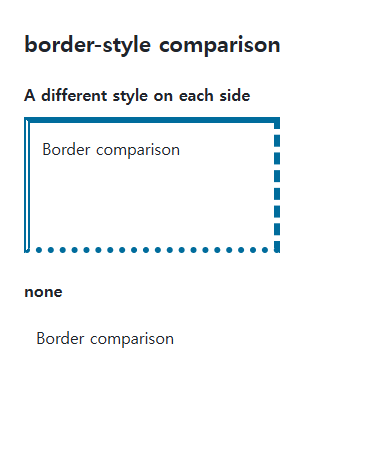
Side ordering
Four values start at the top and proceed clockwise. Two values mean top/bottom and left/right; three mean top, left/right, and bottom. Match each side’s style with its width and color.
Shorthand resets and table conflicts
A later border shorthand can reset earlier side styles. none and hidden look similar on an ordinary box but have different precedence in collapsed-table border conflicts. A none style can also make the computed width zero.
Save this complete document as css-reference-10622-practice.html in UTF-8 and open it in a browser. Test it as a separate file rather than nesting it inside another example.
<!doctype html>
<html lang="en">
<head>
  <meta charset="utf-8">
  <meta name="viewport" content="width=device-width, initial-scale=1">
  <title>Compare none and hidden in collapsed tables</title>
  <style>
    body { margin: 16px; color: #20242b; font: 16px/1.7 sans-serif; }
    main { max-width: 52rem; margin: auto; }
    h1 { font-size: 1.35rem; }
    .samples { display: flex; flex-wrap: wrap; gap: 24px; }
    .samples > * { max-width: 100%; min-width: 0; }
    :focus-visible { outline: 3px solid #005fcc; outline-offset: 3px; }
table { border-collapse:collapse;margin-bottom:20px; } td { padding:12px; } .left { border-right:6px solid #006c9c; } .none { border-left:6px none #006c9c; } .hidden { border-left:6px hidden #006c9c; }
  </style>
</head>
<body>
<main>
  <h1>Compare none and hidden in collapsed tables</h1>
<p>none</p><table><tr><td class="left">Left</td><td class="none">Right</td></tr></table><p>hidden</p><table><tr><td class="left">Left</td><td class="hidden">Right</td></tr></table>
</main>
</body>
</html>
The neighbor’s solid border wins beside none; hidden suppresses other styles on that shared collapsed border. Change only .hidden to none, compare both tables, then restore hidden. Distinguish ordinary invisible borders from collapsed-table conflict precedence.
For using borders and shadows together on components, see CSS Borders, Rounded Corners, and Shadows. Related properties to compare alongside these conditions are border-width.
When the result is missing or unexpected
- Check for none when width and color are correct but no border appears.
- Use sufficient width and inspect zoom if a double border looks solid.

CSS / Reference / background-clip: Background Painting Areas and Text Clipping
Choose border, padding, or content painting areas independently of image positioning. Compare visible boundaries and plan readable fallbacks for text-clipped backgrounds.
CSS / Reference / background-position: Percentages, Centers, and Edge Offsets
Position backgrounds using centers, percentages, or edge offsets. Calculate percentages from the remaining space and account for oversized cover images and multiple layers.
CSS / Reference / background-image: Images, Gradients, Relative Paths, and Layers
Paint gradients or image layers, resolve paths from the correct stylesheet location, and keep meaningful pictures in accessible HTML rather than background decoration.

CSS / Reference / calc(): Calculate CSS Values and Understand Their Types
Combine percentages and lengths with calc(), inspect the actual parent width, and distinguish invalid expressions from newer typed arithmetic and special numeric results.

CSS / Reference / font-family: Font Lists, Glyph Fallback, and Loading
Build a font stack with appropriate generic fallbacks and inspect the fonts actually used. Distinguish naming a family from loading files and covering characters.
CSS / Reference / background-attachment: Viewport, Box, and Internal Scroll Attachment
Compare local and scroll backgrounds inside a scrolling box and distinguish them from viewport-fixed backgrounds. Test target-browser behavior and a usable fallback.

CSS / Reference / border-style: Border Patterns, Side Order, and Hidden Conflicts
Choose border patterns for each side and inspect shorthand resets. Compare none with hidden in collapsed tables and account for zero computed border widths.

CSS / Reference / overflow: Visible Overflow, Scrolling, Hidden, and Clip
Choose clipping and scrolling behavior with appropriate size constraints. Compare hidden with clip and inspect axis interactions and flex minimum sizes.

CSS / Reference / box-sizing: Content and Border Boxes, Including Small-Size Limits
Calculate content-box and border-box sizes, including margins and the minimum content-size limit. Apply resets deliberately and check external components.
CSS / Reference / letter-spacing, word-spacing: Compare Character and Word Spacing
Adjust character and word gaps independently using the same text and a normal baseline. Account for inheritance, language, wrapping, and excessive negative spacing.